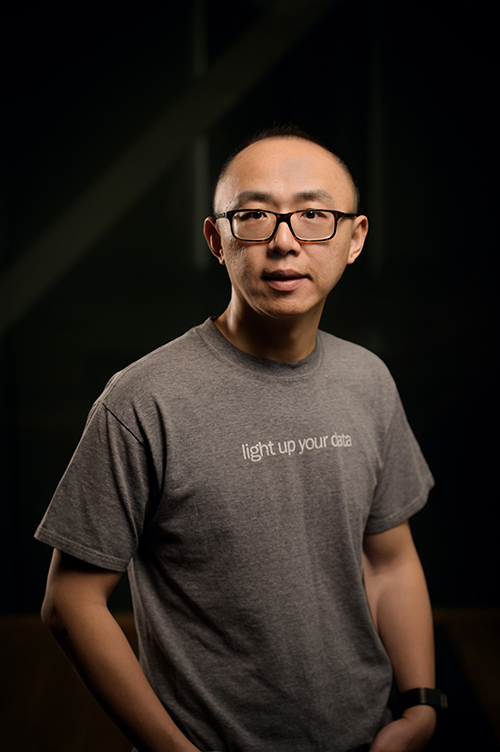
Jiayu Zhou
ProfessorSchool of Information
University of Michigan
Email: [Turn on javascirpt to check the link]
Office: LCSIB 5558
Mail: 5558 Leinweber Computer Science and Information Building, 2200 Hayward St., Ann Arbor, MI 48109
Short Biography Jiayu Zhou is a tenured professor at the University of Michigan School of Information (UMSI). He is an affiliated faculty member of Electrical Engineering and Computer Science (EECS), the Michigan Neuroscience Institute at Michigan Medicine, the Institute for Healthcare Policy and Innovation (IHPI), and the Michigan Institute for Data & AI in Society (MIDAS). Before joining UMSI, Jiayu was a professor of computer science at Michigan State University. Jiayu received his Ph.D. degree in computer science at Arizona State University in 2014. Jiayu has a broad research interest in large-scale machine learning, generative AI, AI+Health and broad AI+X (integrating AI with application domains denoted by "X" to enhance, innovate, or transform the domain).
To Prospective Students: We welcome motivated Ph.D. students! Please apply to the UMSI Ph.D. in Information program; I review applications after the deadline. You are welcome to email me about your research, but I may not be able to reply to every message.
Representative Research
My research develops machine-learning methods for Unified Knowledge Integration: combining evidence fragmented across time, modalities, cohorts, institutions, and biological scales. Four connected areas illustrate this program - longitudinal and distributed health data, conversational biomarkers, drug discovery, and machine-learning foundations. The papers below are selected milestones; Google Scholar provides the complete record.
AI for Longitudinal and Distributed Health Data
Electronic health records are sparse, irregular, incomplete, and shaped by care delivery. With Fei Wang and collaborators, I developed methods for longitudinal phenotyping, time-aware patient representations, and meta-learning from limited cohorts. The program extends to Alzheimer's progression subphenotypes in large EHR cohorts and one-shot GLM analyses that match pooled-data estimates without sharing patient-level records. Across these studies, clinical heterogeneity becomes a source of structure rather than merely noise.
- Qiong Wu et al. COLA-GLM: Collaborative One-Shot and Lossless Algorithms of Generalized Linear Models for Decentralized Observational Healthcare Data. npj Digital Medicine, 2025.
- Manqi Zhou et al. Identifying Progression Subphenotypes of Alzheimer's Disease from Large-Scale Electronic Health Records with Machine Learning. Journal of Biomedical Informatics, 2025.
- Xi Sheryl Zhang, Fengyi Tang, Hiroko H. Dodge, Jiayu Zhou, and Fei Wang. MetaPred: Meta-Learning for Clinical Risk Prediction with Limited Patient Electronic Health Records. KDD, 2019.
- Inci M. Baytas, Cao Xiao, Xi Zhang, Fei Wang, Anil K. Jain, and Jiayu Zhou. Patient Subtyping via Time-Aware LSTM Networks. KDD, 2017.
- Jiayu Zhou, Fei Wang, Jianying Hu, and Jieping Ye. From Micro to Macro: Data Driven Phenotyping by Densification of Longitudinal Electronic Medical Records. KDD, 2014.
Conversational Digital Biomarkers for Cognitive Health
Through I-CONECT and my collaboration with Hiroko H. Dodge, I study conversational speech as an accessible marker of cognitive health. The work spans adaptive dialogue collection, joint acoustic-linguistic modeling, and harmonization across individuals and time. A recent study relates language features to model-derived surrogate CSF biomarkers of amyloid and tau, providing initial biological grounding for language-based markers while motivating validation in cohorts with directly measured biomarkers.
- Yijiang Pang, Liu Chen, Hiroko H. Dodge, and Jiayu Zhou. Bridging Language Markers and Pathology: Correlations Between Digital Speech Measures and Surrogate CSF Biomarkers in Alzheimer's Disease. Alzheimer's & Dementia: Diagnosis, Assessment & Disease Monitoring, 2026.
- Bao Hoang, Siqi Liang, Yijiang Pang, Hiroko H. Dodge, and Jiayu Zhou. Temporal Harmonization: Improved Detection of Mild Cognitive Impairment from Temporal Language Markers Using Subject-Invariant Learning. AMIA Annual Symposium Proceedings, 2025.
- Bao Hoang, Yijiang Pang, Hiroko H. Dodge, and Jiayu Zhou. Subject Harmonization of Digital Biomarkers: Improved Detection of Mild Cognitive Impairment from Language Markers. Pacific Symposium on Biocomputing, 2024.
- Fengyi Tang, Jun Chen, Hiroko H. Dodge, and Jiayu Zhou. The Joint Effects of Acoustic and Linguistic Markers for Early Identification of Mild Cognitive Impairment. Frontiers in Digital Health, 2022.
- Fengyi Tang, Ikechukwu Uchendu, Fei Wang, Hiroko H. Dodge, and Jiayu Zhou. Scalable Diagnostic Screening of Mild Cognitive Impairment Using AI Dialogue Agent. Scientific Reports, 2020.
AI for Drug Discovery and Molecular Design
Working with Mengying Sun, Bin Chen, and collaborators, I developed a progression from domain-aware molecular representation and multi-objective generation to synthesis and biological validation. A 2026 Cell study used predicted transcriptional responses to discover and optimize candidates that reverse disease-associated expression patterns. Recent work extends the program with trajectory-aware tool planning for molecular lead optimization (KDD 2026) and text-guided molecular design through progressive latent diffusion (NeurIPS 2026).
- Lingxiao Li, Haobo Zhang, Bin Chen, and Jiayu Zhou. Chain-of-Generation: Progressive Latent Diffusion for Text-Guided Molecular Design. NeurIPS, 2026 (accepted).
- Lingxiao Li, Haobo Zhang, Ruohao Fan, Bin Chen, and Jiayu Zhou. Molecular Lead Optimization via Agentic Tool Planning. KDD, 2026.
- Jing Xing et al. Deep-Learning-Based De Novo Discovery and Design of Therapeutics That Reverse Disease-Associated Transcriptional Phenotypes. Cell, 2026. Co-corresponding author.
- Mengying Sun, Jing Xing, Han Meng, Huijun Wang, Bin Chen, and Jiayu Zhou. MolSearch: Search-based Multi-objective Molecular Generation and Property Optimization. KDD, 2022. Best Paper Award, KDD Health Day Track.
- Mengying Sun, Jing Xing, Huijun Wang, Bin Chen, and Jiayu Zhou. MoCL: Data-driven Molecular Fingerprint via Knowledge-aware Contrastive Learning from Molecular Graph. KDD, 2021.
Machine Learning Foundations for Knowledge Integration
My foundational work asks when and how models should share information. Early sparse, low-rank, and clustered formulations learned relationships across tasks and became the MALSAR library. Later work extends learning across institutions - without pooling raw records - while addressing heterogeneity, communication constraints, and privacy. These methods support the health and biomedical work above.
- Zhuangdi Zhu, Junyuan Hong, and Jiayu Zhou. Data-Free Knowledge Distillation for Heterogeneous Federated Learning. ICML, 2021.
- Liyang Xie, Kaixiang Lin, Shu Wang, Fei Wang, and Jiayu Zhou. Differentially Private Generative Adversarial Network. arXiv preprint, 2018.
- Liyang Xie, Inci M. Baytas, Kaixiang Lin, and Jiayu Zhou. Privacy-Preserving Distributed Multi-Task Learning with Asynchronous Updates. KDD, 2017.
- Jie Wang, Jiayu Zhou, Peter Wonka, and Jieping Ye. Lasso Screening Rules via Dual Polytope Projection. NIPS, 2013.
- Jianhui Chen, Jiayu Zhou, and Jieping Ye. Integrating Low-Rank and Group-Sparse Structures for Robust Multi-Task Learning. KDD, 2011.
- Jiayu Zhou, Jianhui Chen, and Jieping Ye. Clustered Multi-Task Learning via Alternating Structure Optimization. NIPS, 2011.
For a complete and current record, see Google Scholar and the ILLIDAN Lab site.
Teaching
Jiayu is developing new curricula at both undergraduate and graduate levels, that incorporate the state-of-the-art AI and machine learning into classroom.
- UMich SI 630 Natural Language Processing: Algorithms and People [Winter 2025, 2026]
- UMich SI 376 AI in Practice: Tools and Problem-Solving [Winter 2026] [ Syllabus ]
- UMich SI 311 Applied AI for Problem Solving [Winter 2025] [ Syllabus ]
- MSU CSE 480 [Spring 2022] [ Syllabus ]
- MSU CSE 847 Machine Learning [Spring 2022] [ Syllabus ] [Prev. Spring 2021 - 2016]
- MSU CSE 491/404 Introduction to Machine Learning [Prev. Fall 2020 - 2016]
Service
Jiayu serves as an Associate Editor-in-Chief of Neurocomputing, an Associate Editor for ACM Transactions on Computing for Healthcare and Journal of Alzheimer's Disease, and a Guest Editor for EURASIP Journal on Bioinformatics and Systems Biology and EURASIP Journal on Advances in Signal Processing. Jiayu is a dedicated peer reviewer for leading journals, including the Journal of Machine Learning Research (JMLR), IEEE Transactions on Knowledge and Data Engineering (TKDE), IEEE Transactions on Pattern Analysis and Machine Intelligence (TPAMI), and IEEE Transactions on Neural Network Learning Systems (TNNLS), among others. His contributions extend to serving as a Senior Program Committee member and Area Chair, as well as on organizing committees, for numerous top-tier conferences such as KDD, ICML, NIPS, ICLR, IJCAI, AAAI, and more, where he has held key leadership roles including Program Vice-Chair and Workshop Chair.
Some words keep me moving forward
A job well done is its own reward. You take pride in the things you do, not for others to see, not for the respect, or glory, or any other rewards it might bring. You take pride in what you do, because you're doing your best. If you believe in something, you stick with it. When things get difficult, you try harder.